
How To Talk To Your Consultant About Your Birth Preferences (Without Feeling Dismissed)
Walking into a consultant appointment to discuss your birth preferences can feel surprisingly intimidating, especially when you're planning a VBAC or navigating neurodivergence. You might know exactly what you want for your birth but finding the words to communicate those preferences in a brief, clinical meeting while managing a subtle power dynamic is a whole different skill.
This post covers how to prepare for your consultant appointments, how to frame your VBAC preferences clearly, what to do if you encounter pushback and how to advocate for yourself in a way that protects your peace and keeps you in the centre of your decision-making.
Why These Conversations Can Feel So Hard
Consultant clinics are often fast-paced, highly clinical and framed around risk management. Consultants are trained to look at birth through a lens of clinical risk and protocol. As someone planning a VBAC, your focus includes risk but it also encompasses safety, bodily autonomy, past birth trauma and personal comfort.
If you are autistic, ADHD, or otherwise neurodivergent, these appointments add extra layers of challenge:
Executive function demands: Processing complex medical jargon in real-time while trying to retrieve your own questions.
Masking and compliance: A lifelong habit of pleasing authority figures, which can lead to agreeing to things in the room that you actually feel unsure about.
Sensory environment: Bright fluorescent lights, ticking clocks and noisy waiting rooms that drain your bandwidth before you even step into the consultation room.
Acknowledging that this environment isn't naturally set up for collaborative, nuanced discussions is the first step in changing how you approach it.
The Basics
Before you step into the room, lay the foundation for a productive, structured conversation. Here is what to focus on prior to your appointment:
Prepare a written summary
Do not rely on memory. Bring a short, bulleted list of the specific topics you want to cover (e.g., continuous vs. intermittent monitoring, spontaneous labor vs. induction, or environmental accommodations). Keep a copy in front of you during the appointment.
Set the agenda early
When you sit down, briefly state what you hope to achieve. For example: "I have three specific birth preferences for my VBAC that I’d like to run through today so we can make sure they’re documented in my notes."
Establish a clear communication frame
Let your care team know how you prefer to process information. If you need time to digest options or prefer written visual summaries over spoken clinical jargon, state that upfront.
What Most People Leave Out
Many birthing people go into consultant appointments hoping for a simple "yes" to their preferences. When faced with clinical hesitation or standard policies, conversations often stall. Here is what most people leave out when preparing for these discussions:
Using structured decision-making tools (like BRAIN)
When a recommendation or restriction is mentioned, asking structured questions keeps the conversation objective and balanced:
Benefits: What are the benefits of this option for me and my baby?
Risks: What are the risks or downsides?
Alternatives: What are the alternatives?
Intuition: What does my gut tell me?
Nothing: What happens if we do nothing or wait 24–48 hours?
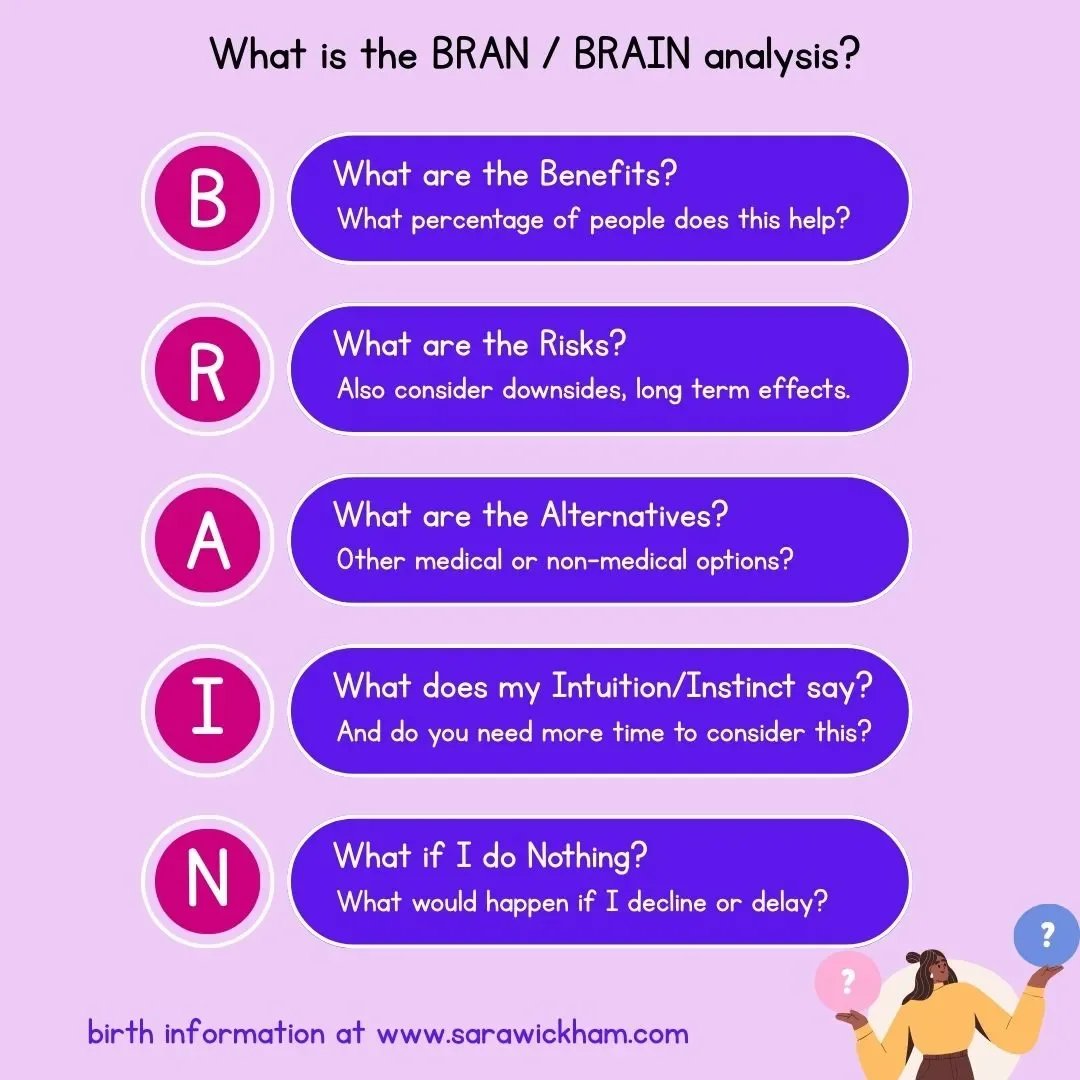
The BRAIN Acronym
This is useful in all areas of life and I find myself using this to advocate for myself and my children even now.
Requesting personalised risk rather than population risk
Consultants frequently quote general population statistics or hospital policies. You are an individual, not a statistic. Asking, "What is my individual risk based on my specific history?" shifts the conversation from blanket policy to individualized care.
Documenting agreed-upon preferences in your electronic notes
A verbal "that should be fine" in a clinic room doesn't guarantee the on-duty midwife at 3 AM will know about it. Always ask: "Could you please write in my notes that we discussed this and agreed on [X]?"
Planning for the "I need to think about it" pause
You do not have to make decisions on the spot during a routine antenatal appointment. Leaving out a strategy to exit the pressure cooker is a common mistake. Practicing a phrase like, "Thank you for explaining that. My partner and I will take some time to discuss this at home and email you our decision" gives you control over the timeline.
A Section For Your Previous Birth
Your consultant appointment is heavily influenced by your obstetric history. If your previous birth involved trauma, feeling unheard or emergency interventions, that context matters today.
You don't need to retell the entire story, but referencing how that experience impacts your current choices can frame your preferences powerfully. For example:
"In my previous birth, I felt overwhelmed when decisions were made quickly without explanation. For this birth, having clear, quiet explanations before any examination or procedure is vital for me to feel safe."
Sharing this helps your consultant understand that your preferences aren't arbitrary; they are informed, deliberate choices designed to support your physical and psychological safety.
If You're Neurodivergent, This Section Matters Particularly
If you are neurodivergent, communicating with consultants requires strategies that explicitly accommodate how your brain works under stress.
Consider using these practical strategies:
Bring a dedicated advocate: Your birth partner or doula should have a clear brief. They aren't just there for moral support; they can slow the conversation down, take note or ask for clarification if they see you freezing.
Name your communication style: It is completely valid to hand over a written statement that says: "When I am processing complex information, I need a moment of silence," or "I process information better when I can read it, could you write down those numbers for me?"
Manage the sensory load: Wear noise-canceling headphones in the waiting room, bring a tactile fidget or ask if overhead fluorescent lights can be dimmed during the appointment.
Use script cards: If verbalizing preferences under pressure causes you to freeze or go non-speaking, write key phrases on index cards to read directly or hand to the clinician.
How Long Should These Conversations Take?
Standard NHS consultant appointments are brief, often scheduled for 10 to 20 minutes. Because time is limited, focus on your top 2 or 3 priority topics per appointment rather than trying to cover every detail of your birth plan in one go.
If you have complex preferences, a history of trauma or need extra time to process information, you can ask your midwife or consultant's secretary to book a longer appointment or schedule a follow-up discussion.
In Short
Talking to your consultant about your VBAC preferences isn't about confrontation; it's about collaborative, informed consent. By bringing a clear structure, using tools like BRAIN, asking for individualised evidence and communicating your processing needs, you can transform these appointments from stressful hurdles into empowering milestones in your birth preparation.
If you would like support preparing your birth preferences, practicing consultant conversations or navigating a previous difficult birth, we can work through it together in virtual or face-to-face antenatal sessions.
Get in touch or read more about ND & VBAC Preparation and Birth Doula Support.
Related reading: